Colorado Trail: Day 19. Sunday, August 17, 2025.
After eating dinner last night, I was tired and, oddly enough, completely worn out, even though it hadn’t been a particularly strenuous day. I decided to save the writing for the morning. I fell asleep right after getting into my tent at 7:00 PM and basically slept through the night until 4:30 AM.
What was also a bit strange yesterday was that I had to pee all day, even though I drank less than usual. For the first time in a long time, my pee bottle, which I use at night so I don’t have to leave the tent, was completely full. The first thing I did when I got up and went out to get my food bag was pee.
We had been in Salida for a day at 2,150 meters (7,054 feet), and now we were back up to around 3,500 meters (11,483 feet). Kidneys excrete more fluid at high altitudes, but I was already acclimated to about 3,000 meters (9,842 feet). It was strange.
I felt from the moment I woke up that it was going to be a tough day. When we started hiking at 6:30 AM, my body felt completely drained of energy. Inger felt the same way.

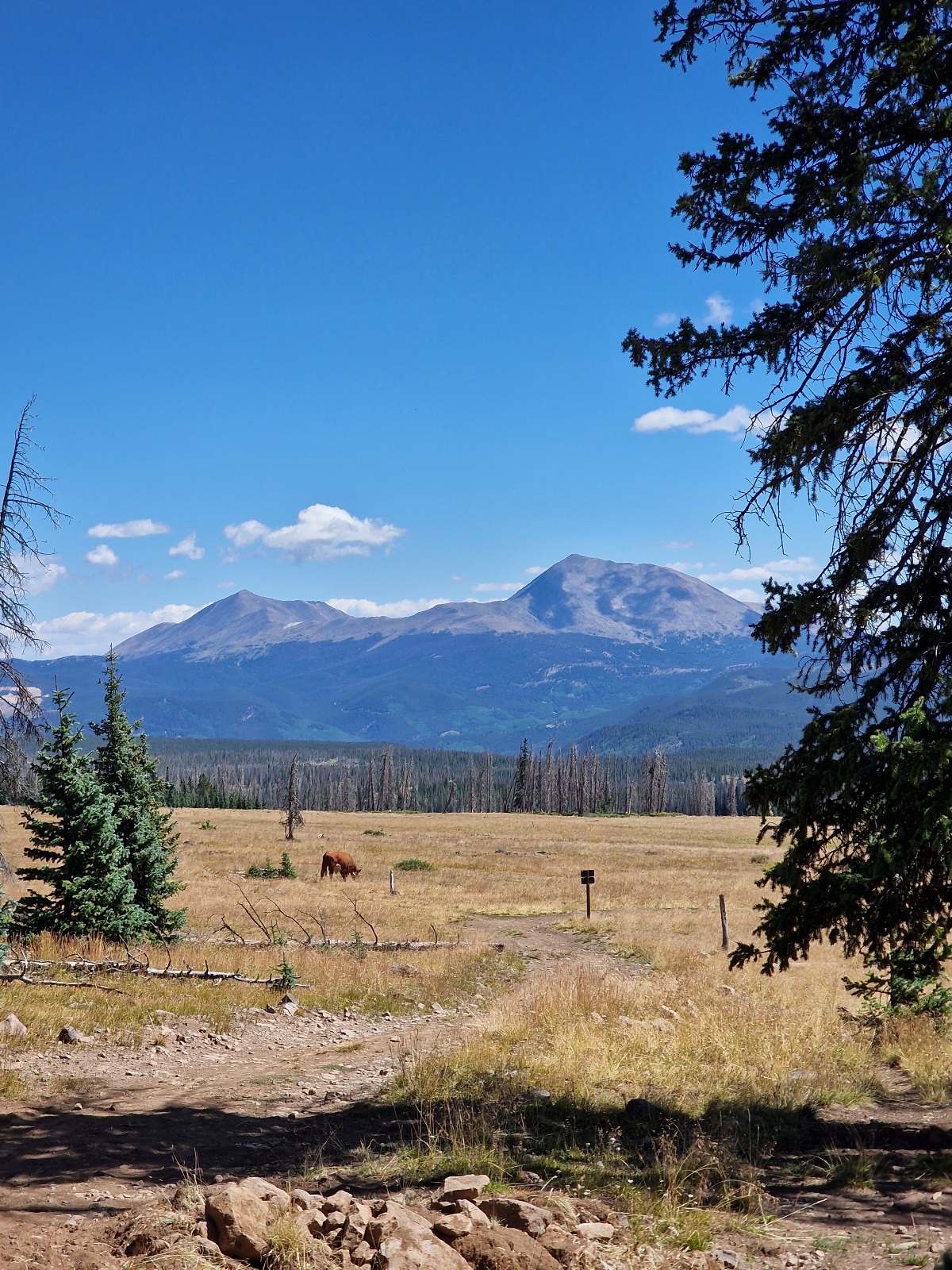
Water was scarce today as well. We pushed ourselves and took our first break after a little less than 9 km (5.6 miles) at the first water source we came to. It was a tiny creek, and we had to share the water with cows grazing in the forest. Of course, there was cow dung everywhere.
I checked FarOut to see where the next water source would be. Yikes, it was 22.5 km (14 miles) away!
«That’s a whole day’s hike,» Inger said.
That meant we would have to hike a total of 31 km (19.3 miles) to get there today. Normally, we could manage that without a problem, but in the shape I was in today, it seemed completely out of reach.
What should we do? Should we fill up 4–5 liters for the entire day and night and dry camp, or should we push on to the water source?
The most sensible thing to do, given how we were feeling, was to choose the first option: dry camp and avoid completely exhausting ourselves.
But you don’t always choose the most sensible option. We decided to go for the next water source. I told Inger that in that case, I wouldn’t be able to carry her sleeping pad. «That’s fine,» she replied.
I filled up enough water for the day, plus a little extra, and we were back on the trail. The trail was difficult to hike on, with a lot of loose rock, so we had to watch every step. I was tempted to go into «zombie mode» and just walk on autopilot, but it was far too risky.

I’ve experienced on previous long hikes that my body can feel incredibly heavy for the first 10 km (6.2 miles) and then suddenly come to life. I hoped for the same today, but it didn’t happen. I made sure to eat often and eat a lot, however.


We took breaks every 5 km (3.1 miles), where we would lie down on the ground and rest. On the ascents, we took it incredibly slow. Fortunately, they weren’t very long today, but we still gained a total of over 1,000 meters (3,280 feet) of elevation over the day. I have rarely felt so heavy.

The last 2 km (1.2 miles) to the water source were thankfully downhill, and it was easier to walk then. The water source was a creek, or what used to be one. Now, water was barely trickling. It ran over a small ledge, and someone had placed a leaf there for the water to trickle along so it could be caught at the end.
It took several minutes to fill a single liter. I filled up enough for the evening, night, and the next morning.
Inger had planned to wash her feet in the creek, but that was just not going to happen.

We continued for another half a kilometer until we found a suitable campsite at about 6:00 PM.
It was an extremely tough and demanding day. I have to admit that I doubted our bodies could handle it back at the first water source, but it’s incredible what you can accomplish when the will is there.
Today’s hike was 32 km (19.9 miles) with a 1,040-meter (3,412-foot) elevation gain. We’re camping at 3,320 meters (10,892 feet).